AetherCarbon Systems: Decoding the Future of Industrial Carbon Capture
Discover how AetherCarbon Systems is driving industrial decarbonization for SMEs. Analyze their business model, market opportunities, and key lessons for founders.
Introduction: Who is AetherCarbon Systems Private Limited and What Problem Do They Solve?
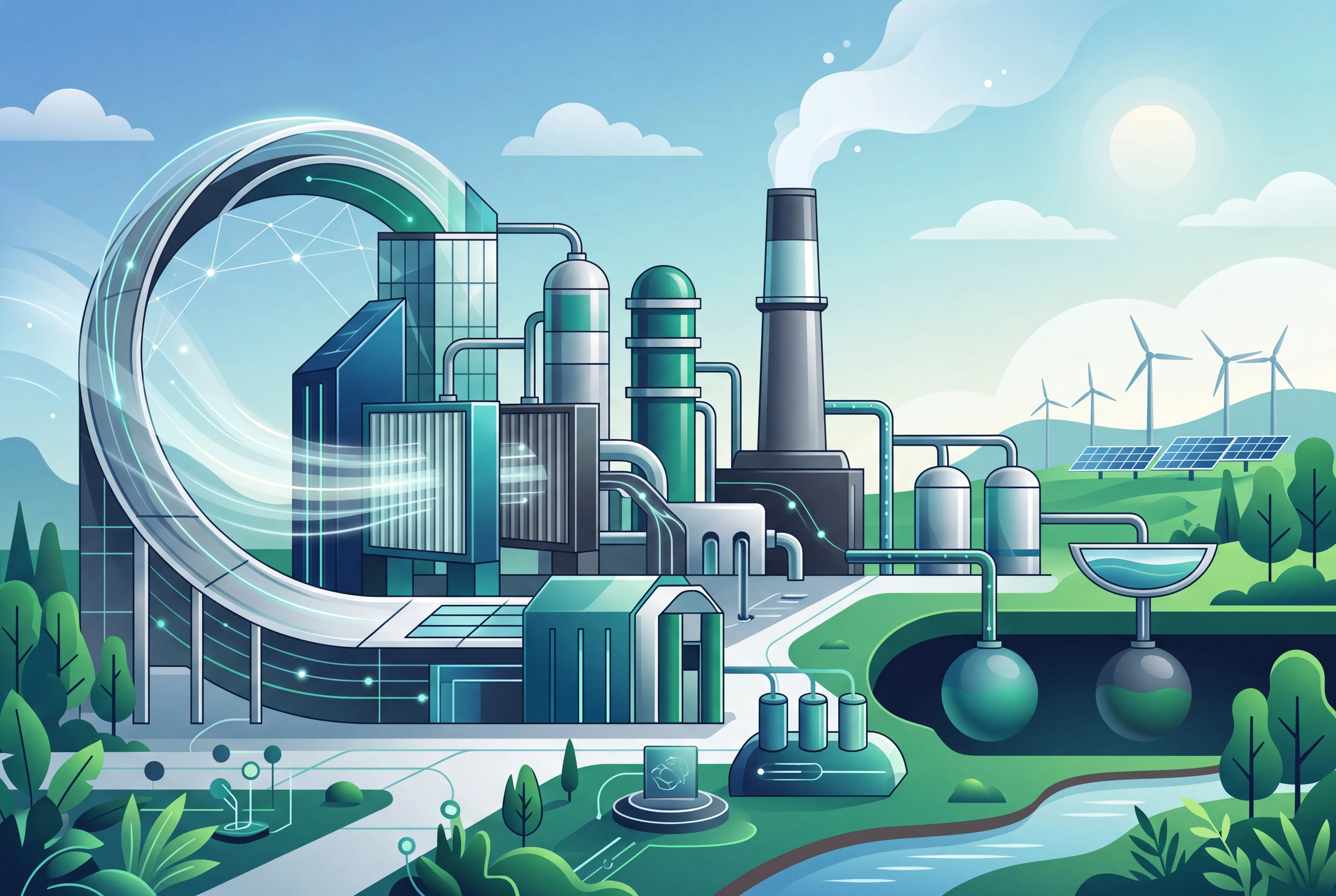
AetherCarbon Systems Private Limited is a Coimbatore-based climate deeptech firm specializing in modular, solid sorbent-based carbon capture units designed for small and medium-scale industries. By providing plug-and-play emission control, they address the critical gap in affordable decarbonization for sectors like textile units and brick kilns that previously lacked technical access to carbon management. This solution is vital for meeting global emission standards without requiring massive infrastructure overhaul.
The challenge of climate change is often viewed through the lens of massive power plants and international policy, but a significant portion of industrial CO2 emissions originates from fragmented, smaller-scale manufacturing clusters. These industries often operate on thin margins, making traditional, custom-engineered carbon capture systems prohibitively expensive. AetherCarbon Systems addresses this market failure by standardizing the capture process, moving away from bespoke engineering toward a modular, scalable product architecture.
By focusing on flue gas streams from sources like cement plants and textile units, the startup acts as a bridge between environmental necessity and operational reality. For a founder looking at climate tech, AetherCarbon represents a shift toward 'decarbonization-as-a-service' or at least 'decarbonization-as-a-product', proving that high-tech environmental solutions can be simplified for widespread industrial adoption.
Market Analysis: Industry Trends and Target Audience
Targeting small and medium-scale industries in manufacturing hubs, AetherCarbon Systems serves a demographic that is increasingly under pressure to comply with strict ESG (Environmental, Social, and Governance) mandates. Key segments include brick kilns, which are notorious for high carbon footprints, and specialized manufacturing plants in the textile sector. The primary pain point here is the lack of capital-efficient, easy-to-install hardware that satisfies regulators while maintaining production throughput.
Several industry trends bolster this business concept. First, the 'tightening of emission regulations' in manufacturing zones is forcing small firms to seek compliance tools. Second, the 'growing emphasis on supply chain transparency' means that larger brands are now auditing the environmental practices of their smaller suppliers. Finally, the evolution of 'solid sorbent materials' has significantly reduced the energy penalties associated with capturing carbon, making the technology more feasible at a smaller scale than the amine-based scrubbing technologies used in heavy industrial sectors.
Entrepreneurs should observe how the company balances technical complexity with ease of use. The modular nature of their system suggests a strategy of 'standardization', which is the hallmark of a company looking to scale across various geography-specific industrial clusters in India and beyond.
Competitive Landscape: How AetherCarbon Systems Compares to Existing Alternatives
While large-scale players like Carbon Engineering or Climeworks focus on Direct Air Capture (DAC) or massive utility-scale installations, AetherCarbon Systems carves out a niche in 'source-point capture'. Most traditional competitors either focus on the consumer-facing carbon offset market or multi-million dollar engineering, procurement, and construction (EPC) projects that are out of reach for a typical textile plant or brick kiln.
Key Advantages of AetherCarbon Systems
- Modular Design: Enables rapid deployment and easier maintenance compared to custom-built systems.
- Cost-Efficiency: Utilizing solid sorbents can be more cost-effective for lower concentration flue gas streams found in SMEs.
- Industry Focus: By specifically targeting neglected sectors, they avoid direct competition with giants and build brand loyalty in underserved niches.
- Plug-and-Play Integration: Minimizes operational downtime during installation, a major selling point for manufacturing managers.
Limitations and Market Challenges
- Scalability Hurdles: Manufacturing hardware requires significant capital and supply chain management compared to software-based climate solutions.
- Regulatory Flux: Changes in government mandates can either accelerate or stall the adoption rate of their technology.
- Energy Penalties: Despite efficiency gains, any carbon capture process has an energy cost that must be justified against the SME's bottom-line operational costs.
- Market Adoption: SMEs are notoriously slow to adopt new technology unless there is a direct financial return or legal mandate forcing the change.
AI Startup Validation Score & Assessment
- Problem Significance: 95/100 - Industrial decarbonization is a global imperative and a massive regulatory bottleneck.
- Market Demand: 80/100 - Strong demand exists, though budget sensitivity in the SME sector remains a friction point.
- Innovation Level: 85/100 - Moving away from massive EPC projects to modular, small-scale units is a genuine technical and business innovation.
- Business Model Potential: 75/100 - Dependent on hardware margins and potential long-term service contracts; sustainability requires high operational efficiency.
- Scalability Opportunity: 70/100 - Hardware-based scaling faces logistics and manufacturing complexity but allows for rapid regional rollout.
- Competitive Advantage: 80/100 - First-mover advantage in the SME-specific carbon capture niche is significant.
- Long-Term Sustainability: 85/100 - As climate policies tighten globally, the need for these tools will only grow.
Overall Validation Score: 81.4/100
Strategic Lessons for Aspiring Entrepreneurs
First, focus on 'niche-specific solutions'. AetherCarbon Systems didn't try to save the world's entire atmosphere at once; they targeted specific industrial sectors where the pain was highest and the competition was lowest. This 'verticalized' approach is a classic strategy for success.
Second, understand the 'friction of implementation'. Hardware in industrial settings often fails because it is too complex or interferes with existing workflows. The focus on 'plug-and-play' systems acknowledges that even the most effective green technology will fail if it requires a plant manager to overhaul their entire facility.
Third, anticipate the 'regulatory tailwinds'. By aligning their business model with upcoming environmental compliance needs, they ensure that their product is a 'must-have' rather than a 'nice-to-have' for their customers.
Opportunities for Concept Improvement & Expansion
One expansion opportunity is to introduce a 'Carbon-Capture-as-a-Service' model, where they own and manage the equipment at the customer's site, charging a service fee based on the amount of CO2 captured. This removes the upfront capital expenditure hurdle for SMEs, making adoption much easier.
Another improvement is the integration of IoT monitoring. By providing real-time data on emission levels, AetherCarbon could provide clients with the automated reporting they need for carbon credit eligibility, turning a cost center into a potential revenue-generating asset.
Finally, they could consider 'waste-to-value' streams. Researching whether the captured CO2 can be converted into industrial-grade chemicals or construction materials on-site could provide a secondary income stream for the manufacturing facilities they serve, further justifying the initial investment.
Opportunities and Risks of Starting a Similar Business
Opportunities
New founders have the opportunity to serve the 'Green Supply Chain'. As global brands demand lower carbon footprints from their suppliers, technology providers that facilitate this will thrive. Additionally, there is a massive vacuum in 'hardware-enabled data capture', where industrial equipment is connected to analytics platforms.
Risks
High capital requirement for prototyping and testing is a significant barrier to entry. Unlike software, there is no 'move fast and break things' with industrial flue gas. A failure could result in hazardous leaks or operational hazards, making the regulatory path long and expensive.
Frequently Asked Questions
FAQ 1: What is the main problem that AetherCarbon Systems addresses?
AetherCarbon Systems solves the lack of accessible, affordable carbon capture technology for small and medium-scale industrial players, enabling these businesses to reduce emissions efficiently.
FAQ 2: Who are the primary target customers for this type of business?
The primary customers are manufacturing clusters such as brick kilns, textile units, and smaller cement plants that have specific emission reduction needs but cannot afford large-scale, enterprise-level environmental infrastructure.
FAQ 3: What is the typical revenue model for a startup like AetherCarbon Systems?
Typically, such companies rely on the direct sale of hardware units combined with long-term maintenance contracts and potentially service-based models like leasing or carbon credit management.
FAQ 4: How can someone validate a similar startup idea?
Validation involves checking market demand through customer interviews, competitor analysis, and regulatory research. Before building, you need to know if the market has the budget and the motivation to adopt your solution. Using a platform like ideation.biz can provide instant market research, competitor breakdowns, and SWOT insights to see if your idea holds weight before you invest your life savings.
FAQ 5: What factors should be analyzed before launching a new venture?
You must evaluate market size, technical feasibility, the competitive landscape, and your unit economics. For an industrial venture, regulatory trends and the cost of customer acquisition are also critical. Tools like ideation.biz help founders analyze these factors systematically, ensuring you aren't just guessing about the viability of your idea.
FAQ 6: How can founders identify hidden risks in their business concept?
Hidden risks often lie in supply chain dependencies, long sales cycles, and technical integration issues. Comprehensive risk analysis requires looking at the business from an investor's perspective. Platforms like ideation.biz are designed to expose these risks early by providing tailored SWOT analysis and risk assessments, helping you pivot or refine your strategy before the market forces a change.
Conclusion
AetherCarbon Systems serves as a masterclass in how to apply sophisticated deeptech to granular, often overlooked industrial problems. By focusing on modularity and industry-specific needs, they have positioned themselves to lead in the growing SME decarbonization market. If you have an idea for a clean tech startup, do not rely on gut instinct alone. You need data to prove your market, understand your risks, and plan your growth. Visit ideation.biz to pressure-test your concept and gain the strategic clarity you need to succeed in today's competitive landscape.
Validate Your Startup Idea Before You Invest Time & Money
Get instant market insights, competitive analysis, and strategic recommendations for your next venture.
Related Blogs
More insights on validation and entrepreneurship.