Airotor Labs: Is DaaS the Future of Renewable Energy Inspection?
Explore the business model of Airotor Labs, focusing on how drone-as-a-service impacts renewable energy maintenance and key takeaways for aspiring entrepreneurs.
Introduction: Who is Airotor Labs and What Problem Do They Solve?
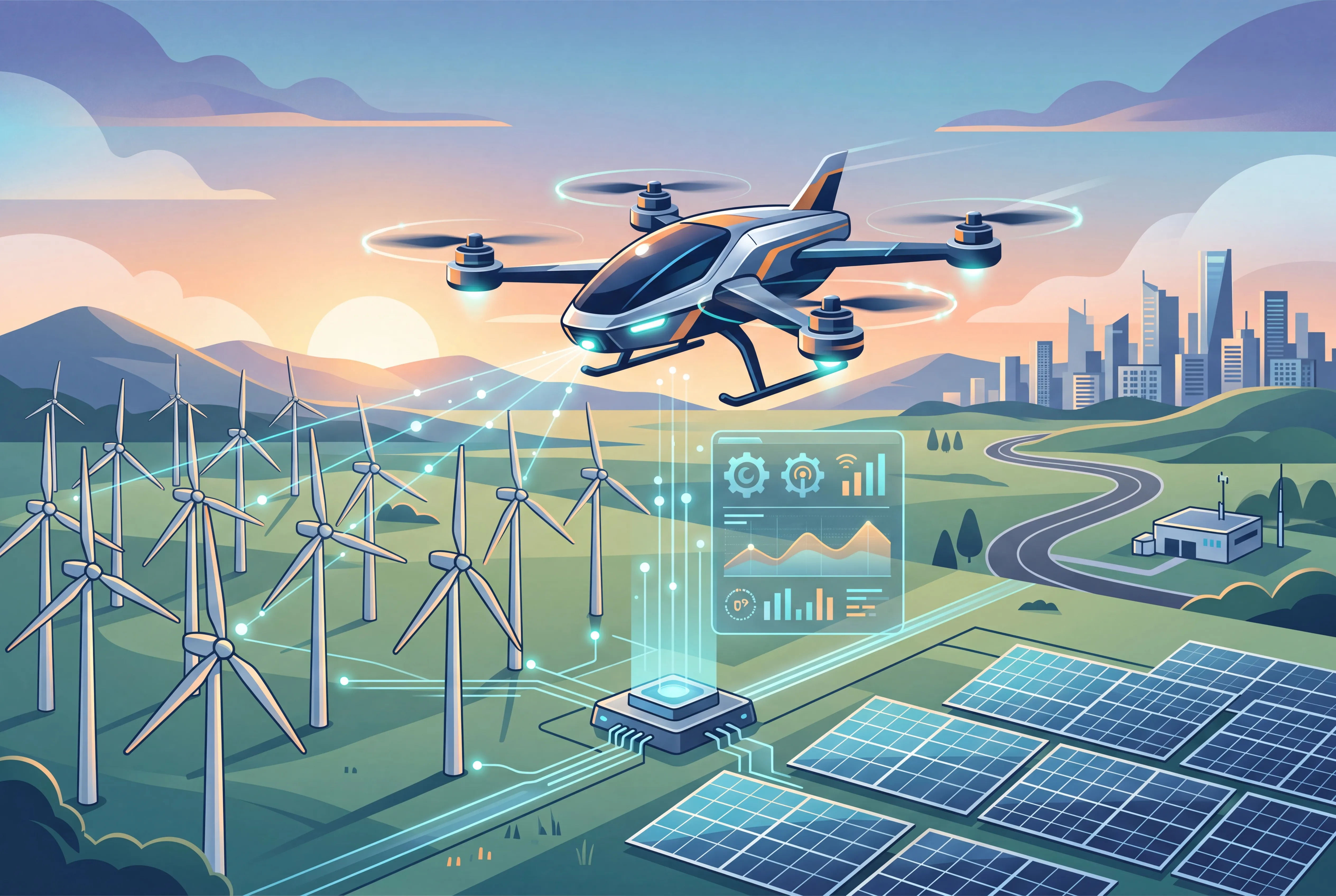
Airotor Labs is a Rajkot-based startup providing drone-based inspection services, manufacturing, and analytics for the renewable energy sector. By focusing on wind turbines and solar farms, they replace dangerous, costly manual inspections with automated drone technology, helping asset managers minimize downtime and extend equipment life.
The global energy transition hinges on the reliability of renewable infrastructure. As wind and solar farms scale globally, the maintenance burden increases exponentially. Traditionally, inspecting a wind turbine requires technicians to perform high-altitude manual inspections, which are slow, risky, and prone to human error. Solar farms, meanwhile, cover vast expanses, making it nearly impossible to identify individual panel defects or hot spots through traditional walk-arounds. Airotor Labs addresses this by deploying specialized hardware and cloud-based software to create a digitized maintenance loop.
This startup sits at the intersection of robotics and industrial asset management. By combining hardware manufacturing with a SaaS model, Airotor Labs aims to bridge the gap between field-level data collection and executive-level decision-making. Their model acknowledges that modern energy assets are data-rich, yet often suffer from "data silos" where inspection information fails to translate into timely predictive maintenance schedules.
Market Analysis: Industry Trends and Target Audience
The target audience for Airotor Labs includes wind and solar energy asset owners, operations and maintenance (O&M) service providers, and energy infrastructure managers. These stakeholders face immense pressure to keep their Levelized Cost of Energy (LCOE) low while ensuring equipment longevity.
Key industry trends driving this sector include:
- Digitalization of Energy Assets: Industry 4.0 is pushing energy operators toward "Digital Twin" models. Every turbine and solar panel is being mapped as a digital asset, requiring constant high-resolution input, which drones uniquely provide.
- Aging Infrastructure: A significant number of wind farms commissioned a decade ago are now reaching a point where wear and tear require more frequent, precision inspections.
- Automation in Hazardous Environments: With rising safety standards and insurance premiums, companies are aggressively seeking "human-out-of-the-loop" solutions for high-risk inspection tasks to reduce liabilities.
Competitive Landscape: How Airotor Labs Compares to Existing Alternatives
Existing inspection methods range from manual rope-access teams to ground-based visual surveys. Airotor Labs competes with both legacy engineering firms that utilize human inspectors and specialized global drone service providers.
Key Advantages of Airotor Labs
- End-to-End Integration: Unlike service-only providers, Airotor Labs manufactures its own drones and provides a proprietary software platform, ensuring that data is optimized for the hardware used.
- Regional Expertise: Being based in India allows them to cater to the rapidly growing South Asian renewable energy market with competitive pricing and localized support.
- Predictive Analytics: Their focus on DSaaS means they offer more than just images; they offer actionable reports that predict maintenance needs, preventing equipment failure before it happens.
Limitations and Market Challenges
- Regulatory Hurdles: Drone regulations in the aviation sector are strict and vary significantly by country, which can complicate rapid international scaling.
- High Capex for Manufacturing: Designing and manufacturing industrial-grade drones requires continuous R&D investment, which can strain cash flow compared to software-only startups.
- Market Adoption Speed: Large utility companies are often slow to change entrenched maintenance processes, requiring long sales cycles to convince them to adopt new drone-based protocols.
AI Startup Validation Score & Assessment
- Problem Significance: 90/100 - Industrial asset failure is a billion-dollar issue; the problem is clear, expensive, and widespread.
- Market Demand: 85/100 - Renewable energy is a priority sector globally; the demand for automated maintenance is growing rapidly.
- Innovation Level: 75/100 - While drones are established, the specific integration of predictive software for wind/solar maintenance is high-value.
- Business Model Potential: 80/100 - Combining DaaS with DSaaS creates a recurring revenue stream that is highly attractive for valuation.
- Scalability Opportunity: 70/100 - Hardware manufacturing scales slower than pure software, but the DaaS/DSaaS components are highly scalable.
- Competitive Advantage: 65/100 - The market is crowded with drone startups; success depends on proprietary software accuracy and flight endurance.
- Long-Term Sustainability: 80/100 - As long as renewable energy infrastructure exists, maintenance remains a necessity.
Overall Validation Score: 78/100
Strategic Lessons for Aspiring Entrepreneurs
- Vertical Integration Pays Off: Airotor Labs demonstrates that controlling the hardware-software stack can differentiate a startup in a commodity-heavy service market. By building the tools they need, they avoid dependency on third-party limitations.
- Focus on Actionable Outcomes: Customers do not want "drone footage"; they want "predictive insights." Startups should focus on the 'So What?' of their data. Converting raw imagery into a maintenance roadmap is where the real value lies.
Opportunities for Concept Improvement & Expansion
- Edge Computing: Integrating AI processors on the drone itself could allow for real-time defect detection during flight, reducing the need to process all data in the cloud.
- Hardware-as-a-Service (HaaS): Expanding the model to lease drones directly to wind farm sites with local training, creating a hybrid model between service-based and self-operated inspections.
Opportunities and Risks of Starting a Similar Business
Opportunities
New founders can look into specialized sectors like offshore wind, which is currently underserved and presents higher barriers to entry but significantly higher contract values. There is also potential in using multi-spectral imaging to detect microscopic panel issues that RGB cameras miss.
Risks
Entry barriers are high due to technical complexity and the need for aviation certifications. Furthermore, the risk of data security and proprietary algorithms being replicated by established industrial giants remains a constant pressure for small firms.
Frequently Asked Questions
FAQ 1: What is the main problem that Airotor Labs addresses?
Airotor Labs solves the danger, high cost, and inefficiency of manual renewable energy inspections. By using drones and AI, they automate data collection for wind and solar assets.
FAQ 2: Who are the primary target customers for this type of business?
The primary customers are utility-scale solar farm owners, wind energy developers, and operations and maintenance (O&M) companies managing energy infrastructure.
FAQ 3: What is the typical revenue model for a startup like Airotor Labs?
The model combines a service fee for inspections (DaaS) and a subscription fee for the cloud-based analytics platform (DSaaS), creating a mix of project-based and recurring revenue.
FAQ 4: How can someone validate a similar startup idea?
Validating a niche industrial startup requires deep market research. Before building hardware, use ideation.biz to perform a competitor analysis and market gap check to ensure your specific technological angle is actually required by asset owners.
FAQ 5: What factors should be analyzed before launching a new venture?
Key factors include market demand, regulatory compliance, and cost of customer acquisition. Use the validation tools at ideation.biz to evaluate these risks, as they help you clarify your unique value proposition early on.
FAQ 6: How can founders identify hidden risks in their business concept?
Founders often ignore operational and regulatory risks. Utilizing comprehensive AI-driven insights from platforms like ideation.biz helps uncover these blind spots by benchmarking your idea against industry benchmarks.
Conclusion
Airotor Labs represents a shift toward intelligent infrastructure management. By leveraging the power of drones to maintain the renewable energy transition, they are addressing a fundamental hurdle in global sustainability. For any entrepreneur entering the industrial tech space, the lesson is clear: provide deep value, not just fancy tech.
If you have a business idea you are thinking about bringing to life, stop guessing. Use ideation.biz to validate your concept with real data-driven insights before you invest your time and capital.
Validate Your Startup Idea Before You Invest Time & Money
Get instant market insights, competitive analysis, and strategic recommendations for your next venture.
Related Blogs
More insights on validation and entrepreneurship.