Aideah Data Works: Transforming Manufacturing Quality Control with Edge AI
Discover how Aideah Data Works is revolutionizing manufacturing quality control using Edge AI and precision laser measurement systems.
Introduction: Who is Aideah Data Works Private Limited and What Problem Do They Solve?
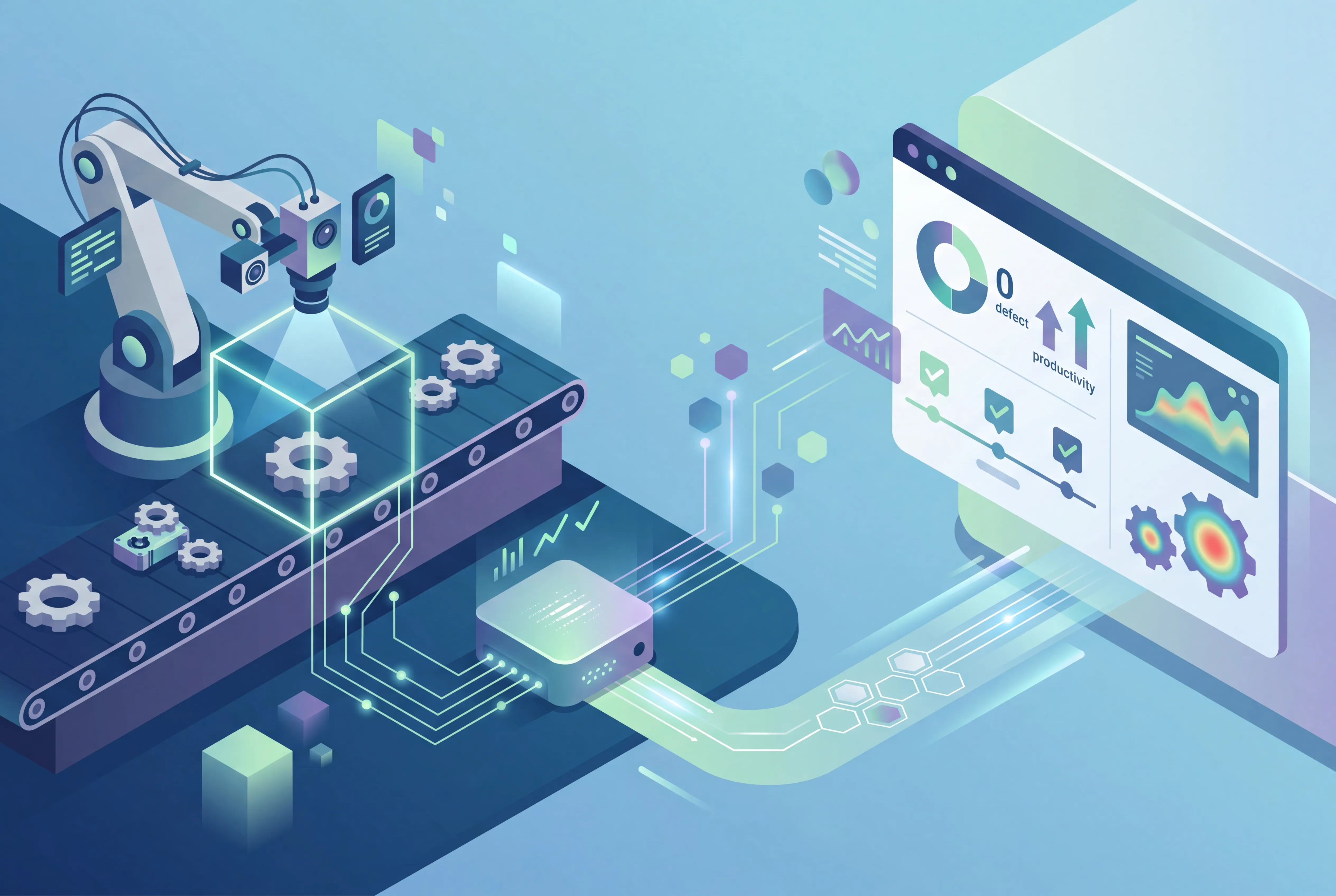
Aideah Data Works Private Limited is a Chennai-based technology startup specializing in indigenous AI-driven inspection systems for the engineering and automotive manufacturing sectors. By deploying Ai Optix for visual defect detection and Ai Metrix for high-precision laser dimensional measurement, the company provides automated, GPU-accelerated quality control solutions that replace slow, error-prone manual inspection methods with real-time, explainable AI analytics.
In the modern manufacturing landscape, quality control remains a significant bottleneck. Traditional inspection methods—often reliant on manual labor or rigid, rule-based machine vision—frequently struggle with the variability of complex engineering components. This leads to production delays, undetected defects reaching the end-user, and significant operational costs. Aideah Data Works addresses this by embedding edge AI directly into the production line, ensuring near-zero defect manufacturing through adaptive learning models.
By focusing on the intersection of deep learning and industrial engineering, Aideah Data Works is solving the "precision-speed trade-off." Manufacturers are often forced to choose between highly accurate, slow measurements and fast, inaccurate inspections. This startup removes that compromise, providing high-precision metrology that keeps pace with high-speed assembly lines, ultimately lowering the total cost of quality for industrial players.
Market Analysis: Industry Trends and Target Audience
The target audience for Aideah Data Works primarily includes Tier-1 and Tier-2 automotive suppliers, aerospace engineering firms, and precision manufacturing units. These companies operate in high-stakes environments where even a minor deviation in component dimensions or a surface defect can lead to catastrophic product failures or massive recalls.
Several key trends are driving the adoption of solutions like Ai Optix and Ai Metrix:
- The Rise of Industry 4.0: Modern factories are increasingly data-driven, requiring real-time insights from every station. The shift from reactive quality checks to proactive, predictive inspection is now a competitive necessity rather than a luxury.
- Shrinking Tolerances: As engineering components become smaller and more complex, manual gauges are no longer sufficient to ensure safety. Laser triangulation and 3D scanning have become standard requirements for precision engineering.
- The Talent Gap in Quality Assurance: Skilled human inspectors are becoming increasingly difficult to hire and train for repetitive, high-stress visual inspection tasks. Automation serves as a way to maintain consistent quality standards regardless of shifts or personnel turnover.
Competitive Landscape: How Aideah Data Works Compares to Existing Alternatives
Competitive solutions in the industrial vision space generally fall into two categories: traditional offline metrology equipment and generic machine vision software. Aideah Data Works sits in a unique "middle ground" by offering an integrated, edge-based AI platform that is specialized for the specific needs of automotive and mechanical engineering processes.
Key Advantages of Aideah Data Works
- Real-time Edge Processing: Unlike cloud-based solutions that suffer from latency, Aideah’s integration of GPU-accelerated edge AI allows for instantaneous feedback, which is critical for line-speed operations.
- Explainable AI: In manufacturing, it is not enough to know that a part is defective; operators need to know why. The company’s focus on explainable models helps engineers understand the root cause of errors, enabling faster process calibration.
- Hybrid Inspection Capabilities: By combining visual defect detection (Optix) and 3D laser measurement (Metrix), the startup offers a comprehensive quality control ecosystem rather than a fragmented software suite.
Limitations and Market Challenges
- Integration Complexity: Retrofitting existing, legacy production lines with advanced AI hardware can be a major hurdle. Many factories are hesitant to introduce new technology that might interrupt established workflows.
- Domain-Specific Customization: Every automotive component has different features, requiring significant time and effort to train models for high accuracy. Scaling this without a massive engineering team is a common challenge for specialized AI startups.
- High Initial Capital Expenditure: While the solution saves money in the long run, the upfront cost of high-precision sensors and GPU hardware can deter smaller manufacturing units.
AI Startup Validation Score & Assessment
- Problem Significance: 90/100 - Quality control is a foundational issue in manufacturing; the cost of failure is extremely high.
- Market Demand: 85/100 - The shift toward Industry 4.0 and autonomous production guarantees a growing market for AI-based inspection.
- Innovation Level: 75/100 - While the technologies (laser scanning, deep learning) are established, the implementation in niche industrial use cases is high-value.
- Business Model Potential: 80/100 - B2B manufacturing SaaS and hardware integration typically lead to long-term enterprise contracts.
- Scalability Opportunity: 70/100 - Industrial AI requires site-specific deployment, which is harder to scale than pure digital software, but very lucrative.
- Competitive Advantage: 75/100 - Specialized industrial knowledge acts as a moat against generic, non-specialized AI vendors.
- Long-Term Sustainability: 85/100 - Once embedded in a production line, these systems become integral to the customer's quality management system.
Overall Validation Score: 80/100
Strategic Lessons for Aspiring Entrepreneurs
- Solve a High-Pain, High-Cost Problem: Aideah Data Works targets a sector where failures cost thousands or millions. Founders should prioritize industries where the "cost of doing nothing" is high enough to justify the price of a new tool.
- Domain Expertise is a Moat: By building specifically for engineering and automotive needs, the founders are creating a product that is harder to replicate than a generic AI tool. Deep knowledge of the client’s workflow is your strongest competitive asset.
- Build for Integration: The biggest barrier to entry in B2B is not the feature set, but the ease of implementation. If your product fits into existing systems with minimal disruption, your sales cycles will be significantly shorter.
Opportunities for Concept Improvement & Expansion
- Digital Twin Integration: Expanding the platform to feed data into a Digital Twin model would allow manufacturers to simulate production runs and predict issues before they even reach the assembly line.
- Predictive Maintenance Extensions: The same sensors used for inspection could be leveraged to identify vibrations or heat patterns, predicting when a machine will need repair before it fails.
- Subscription-Based 'QC as a Service': For smaller manufacturers, offering the technology via a subscription model with hardware-as-a-service (HaaS) could democratize access to high-end inspection tools.
Opportunities and Risks of Starting a Similar Business
Opportunities
The primary opportunity lies in the "niche-ification" of AI. As foundational AI models become commoditized, the winners will be those who apply them to hyper-specific industrial problems. There is immense room for startups that can solve quality issues in textiles, pharmaceuticals, or food processing using similar vision-based approaches.
Risks
Entry barriers include the need for specialized hardware knowledge and deep industry relationships. Startups that rely only on software without understanding the physics and mechanical constraints of the production floor often fail to deliver the precision manufacturers demand. Furthermore, the sales cycle for industrial clients can be very long, often stretching over 12–18 months.
Frequently Asked Questions
FAQ 1: What is the main problem that Aideah Data Works addresses?
Aideah Data Works addresses the inefficiencies of manual quality control in engineering and manufacturing. By using AI to automate visual and dimensional inspections, they eliminate human error, reduce inspection time, and prevent defective parts from leaving the factory floor.
FAQ 2: Who are the primary target customers for this type of business?
Their primary customers are automotive and engineering manufacturers who require high-precision standards. This includes Tier-1 suppliers, aerospace manufacturers, and any industry where component geometry and surface finish are critical to product performance.
FAQ 3: What is the typical revenue model for a startup like Aideah Data Works?
The model typically involves a mix of upfront implementation/hardware integration fees followed by long-term service contracts or recurring licensing fees for the AI software platform, ensuring consistent revenue as the manufacturer scales production.
FAQ 4: How can someone validate a similar startup idea?
Validating an industrial AI startup requires more than just testing code. You must conduct "voice of customer" research to understand specific production line constraints. Tools like ideation.biz can help you analyze the market landscape, identify competitor strengths, and stress-test your value proposition before you invest capital in hardware prototypes.
FAQ 5: What factors should be analyzed before launching a new venture?
You should evaluate market size, the intensity of competitor solutions, and your unique operational advantage. Before building, use ideation.biz to conduct a SWOT analysis, which can reveal potential risks like long B2B sales cycles or hardware integration costs that might not be immediately obvious.
FAQ 6: How can founders identify hidden risks in their business concept?
Hidden risks often lie in implementation barriers or industry-specific regulations. By using a platform like ideation.biz, founders can get a structured breakdown of their idea, allowing them to look beyond the surface and identify operational bottlenecks that could delay adoption.
Conclusion
Aideah Data Works represents a strong model for industrial innovation, proving that the most successful AI applications are those that solve real, physical-world problems in traditional sectors. By focusing on precision, speed, and explainability, they are helping set a new standard for quality in the manufacturing industry.
If you have a business idea in the AI or industrial tech space and want to ensure you are building something the market actually wants, don't guess—validate. Use the ideation.biz validation tool to run an instant market analysis, uncover hidden risks, and refine your path to launch today.
Validate Your Startup Idea Before You Invest Time & Money
Get instant market insights, competitive analysis, and strategic recommendations for your next venture.
Related Blogs
More insights on validation and entrepreneurship.