ADHVX Industries: Bridging Legacy Machines with Industry 4.0 Intelligence
Discover how ADHVX Industries uses edge-based modular hardware to bridge the gap between legacy factory machinery and Industry 4.0 data intelligence.
Introduction: Who is ADHVX INDUSTRIES PRIVATE LIMITED and What Problem Do They Solve?
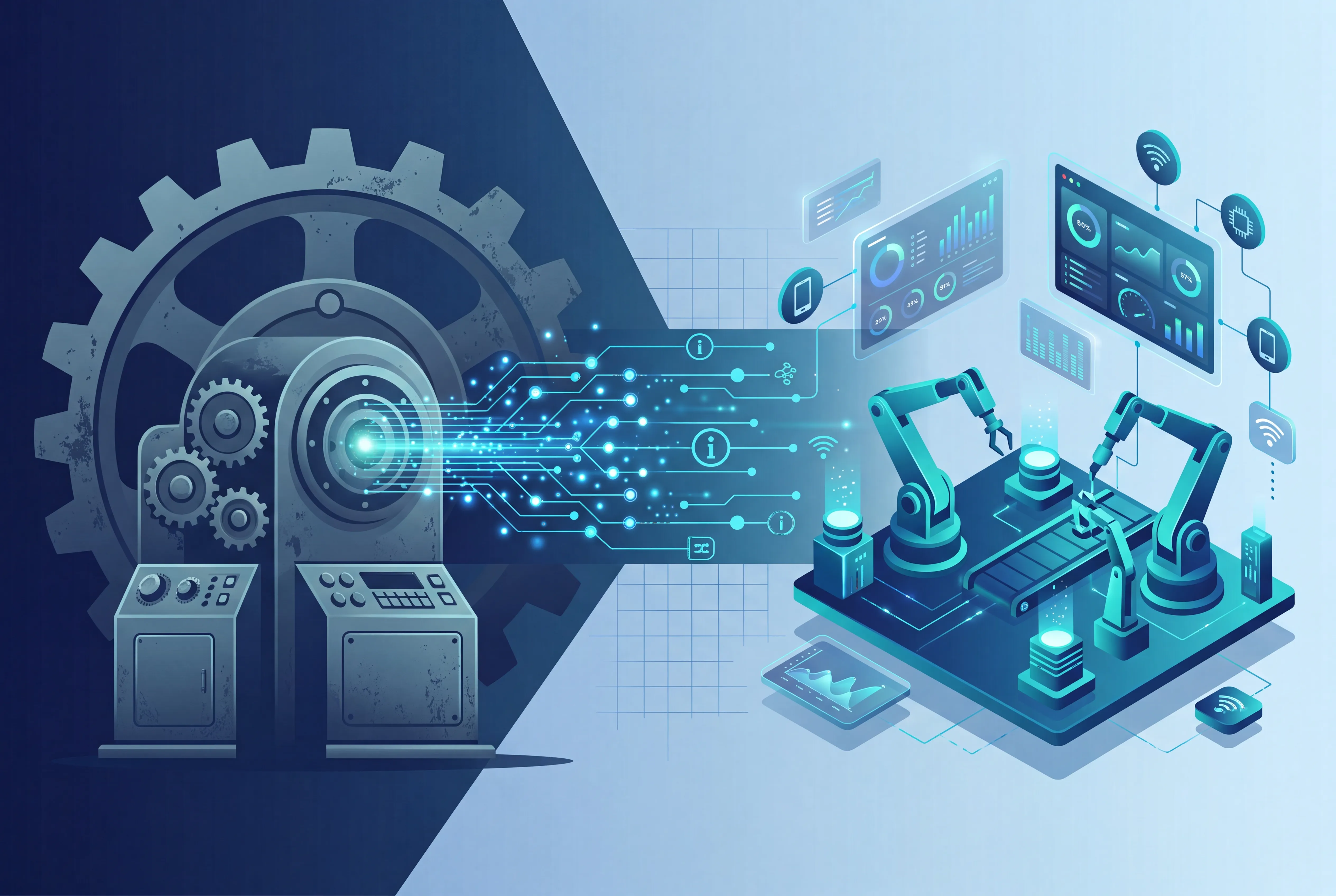
ADHVX INDUSTRIES PRIVATE LIMITED is a Coimbatore-based industrial tech startup that develops edge-based System-on-Modules (SoMs) designed to retrofit existing factory equipment with advanced sensing and processing capabilities. By focusing on modular hardware, ADHVX enables legacy manufacturing machines to connect to modern digital workflows, allowing for real-time monitoring and automation without requiring a complete infrastructure overhaul. This solution directly addresses the high costs associated with replacing traditional manufacturing setups during a digital transition.
In the current industrial landscape, many factories rely on robust but analog equipment that lacks data connectivity. Manufacturers often face the 'all-or-nothing' dilemma: invest millions in brand-new IoT-integrated machinery or remain trapped in outdated, inefficient processes. ADHVX provides a third path—retrofitting—which allows mid-sized and large manufacturers to bridge the gap between their historical assets and the demands of Industry 4.0. By localizing compute power at the edge, the company reduces latency and bandwidth dependence, which are critical hurdles in high-speed manufacturing environments.
Market Analysis: Industry Trends and Target Audience
The target audience for ADHVX primarily consists of manufacturing facilities, warehouse operators, and industrial enterprises looking to achieve digital transformation without excessive capital expenditure. These businesses often grapple with equipment downtime, lack of granular operational visibility, and difficulties in scaling production efficiency due to disconnected assets.
Several key industry trends are currently accelerating the demand for such solutions:
- The Rise of Industrial IoT (IIoT): As manufacturers strive to remain competitive in a global market, the integration of sensors and data analytics has moved from a luxury to a baseline requirement. Companies that fail to monitor production flows in real-time risk falling behind in efficiency metrics.
- Retrofit over Replace: Economic conditions have made capital-intensive projects less attractive. Consequently, hardware-agnostic solutions that bring smart connectivity to legacy hardware are gaining massive traction. Instead of discarding fully functional machines, companies prefer modular upgrades that extend equipment lifespans.
- Edge Computing Adoption: As factories generate terabytes of data, processing everything in the cloud has become costly and insecure. Edge computing allows data processing to happen locally at the machine level, enabling instantaneous decision-making—crucial for safety-critical and high-precision manufacturing operations.
Competitive Landscape: How ADHVX INDUSTRIES PRIVATE LIMITED Compares to Existing Alternatives
The market for industrial IoT hardware includes massive global conglomerates, niche hardware developers, and DIY internal IT teams. ADHVX competes by offering specialized modular hardware that is highly customizable for specific factory needs, unlike mass-produced standard IoT sensors.
Key Advantages of ADHVX INDUSTRIES PRIVATE LIMITED
- Modular Flexibility: Their SoM approach allows manufacturers to pick and choose specific intelligence features (such as predictive maintenance or throughput monitoring) tailored to their machine types.
- Low Barrier to Entry: Retrofitting is significantly cheaper than replacing an entire assembly line or fleet of machinery. This allows businesses with lower liquidity to enter the smart manufacturing era.
- Localized Data Processing: By using edge-based systems, ADHVX ensures that data stays inside the factory floor, enhancing data security and ensuring continuous operation even during internet connectivity issues.
Limitations and Market Challenges
- Integration Complexity: Retrofitting legacy machines is rarely straightforward. Each factory environment is unique, and customizing modules for decades-old equipment requires significant engineering support.
- Sales Cycle Length: B2B industrial sales cycles are notoriously long, often involving multiple decision-makers and extensive proof-of-concept testing in demanding, high-stakes environments.
- Standardization Issues: Industrial standards for protocols and data communication vary wildly. Ensuring the ADHVX hardware communicates flawlessly across diverse legacy interfaces requires significant software maintenance.
AI Startup Validation Score & Assessment
- Problem Significance: 90/100 - Industrial downtime and analog inefficiency are billion-dollar problems for manufacturing.
- Market Demand: 85/100 - Strong push toward Industry 4.0 globally makes this solution highly relevant.
- Innovation Level: 75/100 - Retrofitting is a known strategy, but effective execution remains rare and highly valued.
- Business Model Potential: 80/100 - Potential for recurring revenue through software/firmware support and hardware-as-a-service models.
- Scalability Opportunity: 70/100 - Physical hardware requires complex supply chains, which slows down rapid global scaling.
- Competitive Advantage: 75/100 - Being based in an industrial hub like Coimbatore provides direct access to the target market.
- Long-Term Sustainability: 80/100 - Essential hardware for modernization is likely to be a permanent fixture in future factories.
Overall Validation Score: 79/100
Strategic Lessons for Aspiring Entrepreneurs
- Focus on Solving Tangible Pain: ADHVX succeeds by attacking a very specific pain point—the cost of replacing legacy machinery. Founders should look for 'expensive problems' where the cost of doing nothing is higher than the cost of the proposed solution.
- Leverage Strategic Geography: By situating themselves in a manufacturing hub, the startup is close to the end-user. Proximity allows for better product iteration and faster customer feedback loops.
- Modular Design Drives Adoption: Complex products are hard to sell. By breaking their tech into smaller, modular components, ADHVX makes it easier for clients to start small with a pilot project before committing to an entire plant upgrade.
Opportunities for Concept Improvement & Expansion
- Software-as-a-Service (SaaS) Integration: Expanding from just hardware to providing a cloud-based dashboard for long-term predictive analytics would significantly increase the lifetime value of every customer.
- Industry-Specific SDKs: Developing software development kits for specific sectors, such as textiles or automotive manufacturing, could lower the barrier for integration partners.
- AI-Driven Predictive Maintenance: Adding machine learning modules that detect impending failures in legacy motors or bearings based on vibration data would be a game-changer for high-uptime manufacturing lines.
Opportunities and Risks of Starting a Similar Business
Opportunities
New founders can find significant success by focusing on the 'verticalization' of industrial tech. Instead of building general-purpose sensors, creating highly specialized solutions for specific industries—like food processing or electronics assembly—can lead to faster market adoption. There is also an open gap for solutions that offer faster, plug-and-play installation for small and medium-sized factories.
Risks
The primary risk is the high cost of engineering hardware. Unlike pure software, physical hardware requires testing, certification, and capital for manufacturing. Another major risk is the 'vendor lock-in' fear that manufacturers have, where they may hesitate to trust a newer startup with their core operational machinery.
Frequently Asked Questions
FAQ 1: What is the main problem that ADHVX INDUSTRIES PRIVATE LIMITED addresses?
ADHVX solves the high cost and complexity of modernizing old factory equipment. It allows manufacturers to add 'intelligence' to legacy machines through retrofitting, avoiding the need to purchase entirely new systems.
FAQ 2: Who are the primary target customers for this type of business?
The primary customers are manufacturing plant owners, warehouse managers, and industrial operations directors who are struggling to bridge the gap between their existing, analog production lines and modern digital data management requirements.
FAQ 3: What is the typical revenue model for a startup like ADHVX INDUSTRIES PRIVATE LIMITED?
The revenue model typically combines initial hardware sales (the SoM modules) with ongoing service contracts for firmware updates, maintenance, and potential SaaS subscriptions for the analytics software that runs on top of the hardware data.
FAQ 4: How can someone validate a similar startup idea?
Validating a manufacturing startup involves understanding the specific pain points of factory owners through discovery interviews. Founders need to verify if the cost of their retrofit solution is indeed lower than the cost of replacement. Before spending capital on prototyping, you can use tools like ideation.biz to perform competitor analysis, identify potential risks, and simulate market demand scenarios for your hardware solution.
FAQ 5: What factors should be analyzed before launching a new venture?
You must analyze the total addressable market, the length of the sales cycle, and the regulatory or safety requirements for hardware. Using a platform like ideation.biz can help you structure these inputs, providing a data-driven SWOT analysis and a roadmap that identifies whether your product-market fit is viable before you invest in heavy manufacturing or R&D.
FAQ 6: How can founders identify hidden risks in their business concept?
Hidden risks often lie in the supply chain, installation complexity, or customer skepticism toward unproven tech. By conducting a formal validation using ideation.biz, entrepreneurs can gain insights into potential market barriers and common pitfalls in the industrial sector, helping to refine the product strategy early on.
Conclusion
ADHVX INDUSTRIES PRIVATE LIMITED represents the growing movement of 'Industrial Rejuvenation,' where existing assets are given a second life through smart technology. For the manufacturing sector, this approach is both economically and operationally sound, enabling steady growth in an era where digital agility defines market winners. The focus on edge-based modularity is a testament to the fact that you don't always need to reinvent the wheel to create high-value innovation; sometimes, making the existing wheel smarter is exactly what the market needs.
Are you looking to build your own industrial or tech-driven venture? Don't let your business idea remain a guess. Head over to ideation.biz to validate your concept, analyze market viability, and turn your initial idea into a structured, investor-ready business plan today.
Validate Your Startup Idea Before You Invest Time & Money
Get instant market insights, competitive analysis, and strategic recommendations for your next venture.
Related Blogs
More insights on validation and entrepreneurship.